
Warming up with the phonation tube – the five-note pattern

I favour a warm-up for the voice which helps to gradually bring it into full use. Over the years, both as a jobbing opera singer and a singing teacher, I have come to rely upon the five-note pattern as an excellent provider of my requirements. I want something to offer a gentle stretch but not over too wide a range of notes and which has the capacity to challenge breath control. As an open-voiced exercise, it can be used to check that vowels remain the same quality throughout the range, to encourage a seamless legato with no aspirations in between each note and to focus on intonation or even resonance. In the music we need to sing, we often come across scalic passages or stepwise intervals, therefore this warm-up also serves as a technical exercise to set up good muscle-memory which means we can focus on something else, leaving the voice to instinctively know how to sing those types of passage.

In the video, Georgie, a teenage student uses the phonation tube to sing the five note warm-up. You’ll notice that here we have used a pint glass which means it’s really easy to see her breath output – if this falls, we know that her support is not working as well as it needs to. In the glass, there is quite a large depth of water, this makes her breathing support muscles work harder (the less depth, the less resistance and the easier it is). Working with the tube we are looking for bubbles, for air flow and to provide pressure above the cords to help them close more efficiently without the pressure underneath the cords becoming too much – essentially balancing the pressure both sides of the vocal cords. Abdominal support is added cumulatively as we approach the end of the breath. The sound output is quite small in this instance as producing a large sound is not the point of the exercise. We’re aiming for an unbroken legato which is in tune and easy to produce. In the course of a minute, the voice is taken gently across an octave and through the upper passaggio. During the tube use, it lets the student focus on other issues rather than the sound they are producing. These issues can be breath focussed or on the shaping part of the technical process, where we attempt to consciously open the back of the throat fully to create space for the free vibration taking place.

After this exercise we might try the same exercise again, without the tube, trying to recreate the freedom the tube characteristically gives and to replicate any of the lessons learned by tube-use, whatever they may be, on each occasion.
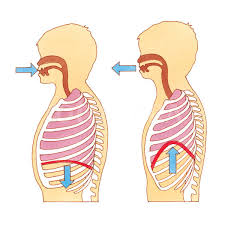
And breathe….

In the course of my teaching I work with a wide-ranging clientel, from those who are advanced students of singing, aspiring to a professional career in performing, to those who simply want to sing better. I have taught children as young as 7 and adults who are well into their 70’s. I have taught in classrooms and on courses and run workshops. It actually does not matter who your students are. They have one thing in common.

Breath is literally the life of their music. Finding ways to manage breath are not just as simple as putting a breath-mark in the score and breathing at that point. The way you approach that inspiration (and I use the word in more than one sense) is totally key to the success of the next phrase. If your previous phrase has finshed with your breathing out-of-control and in a panic, this affects the ability to move forward. Conversely if you are still holding breath at the end of the last phrase, just topping up can mean that you create tension in the voice and also are unable to control much of the air you have taken in.

One of my friends and colleagues over the years has been Paul Esswood, the counter-tenor. We once discussed the breath issues surrounding the alto aria ‘Esurientis’ from Bach’s Magnificat, which has an impossibly long instrumental-type phrase where breathing seems wrong. He attributed his ability to sing this phrase in one breath to preparation, at least a couple of breaths before the breath on which it is sung.

In addition to the mechanism of breathing-in, there is the emotional and communicative element of the music to add into the mix. Then, in performance, there are possible nerves, and other issues demanding our concentration. It is no wonder that almost all of us singers find difficulty with breathing at some point.

A wise singing-teacher once told me that the most control one has in singing is when one is not in control. In my humble opinion, she was right. The more you trust in the simple physical process and the emotional connections to your breath, the easier breathing, and singing becomes. If you have to ‘think’ too hard and there is a delay in the action, this causes a lack of fluency, adds inappropriate tension and control is lost.

To arrive at this simple state however, is a more difficult process! It requires one to re-train lazy abdominal muscles to support the breath-pressure one needs and also then relax to allow full breath replenishment, align posture, release tension in the throat and facial muscles and understand the massive importance that the exhalation has to the next breath and therefore the resulting sound that it is then possible to produce.

Phonation tubes can have an impact on teaching students about how to release breath consistently and in a controlled manner. Because it is possible to see that breath being released in the form of bubbles, and, at this point, sound is of a secondary concern to that release, this feedback is invaluable. Some students have remarked that they can feel what they should be doing with their diaphragms in a real way for the first time, because until you know what you are doing, it feels hit-and-miss. The back-pressure provided by blowing the bubbles into water makes this magic happen. There is no sound to be desperately concerned about ( even the most gorgeous voice sounds like a gurgling baby’s) so it helps direct attention to what is happening within the body, which means that undesirable shoulder movements, chest-caving, protruding heads and other destructive tensions are clearer and therefore more easily rectified.